Guide 7 min read
How to choose a massage course: seven things to check
A course costs several thousand złoty, and schools' offers sound alike. Before you pay a deposit, check seven things with the school.


A massage course costs several thousand złoty and takes a few days out of your calendar, and every offer in the search results sounds the same. Each one promises hands-on practice, a certificate and qualified instructors. Only after you book do you find out how many of those words were backed by anything.
Below are seven things you can check before you pay, and a few warning signs. None of these points requires any knowledge of massage. All it takes is asking a specific question and comparing the answer with what the website says.
First, decide what you want to do after the course
This is the one point nobody can check for you, and it shapes everything else.
A good course looks different for someone who wants to massage a partner and friends, different for someone opening a practice, and different again for a massage therapist with several years of experience who is looking for one new service for their price list. The first needs safe fundamentals and the confidence that they won't hurt anyone. The second needs a complete, repeatable sequence that can be sold as a treatment. The third needs a technique the salon next door doesn't offer.
If you don't name that goal, you'll buy a course based on its description, not on how well it fits. Good schools name it themselves: the course page says who it is for and who it is not for. A section like "this probably isn't for you" isn't coyness, it's a sign that someone chooses participants deliberately instead of taking everyone.
Check how much time you will spend with your hands on the body
You can't learn massage from a slideshow. It can help you understand what is being done, but it can't let you feel how much pressure to use, how slowly to move your hand and at what moment the tissue gives way. That only comes through repetition under the eye of someone who corrects you.
So don't ask about the number of hours, ask about the proportions. How much of the stated time is work at the massage table, and how much is theory, breaks and demonstrations. A claim like ninety percent practice can be verified: ask for an outline of the daily schedule.
If the schedule includes three hours of anatomy from a projector and an hour for questions, it is not a practical course, no matter what it is called.
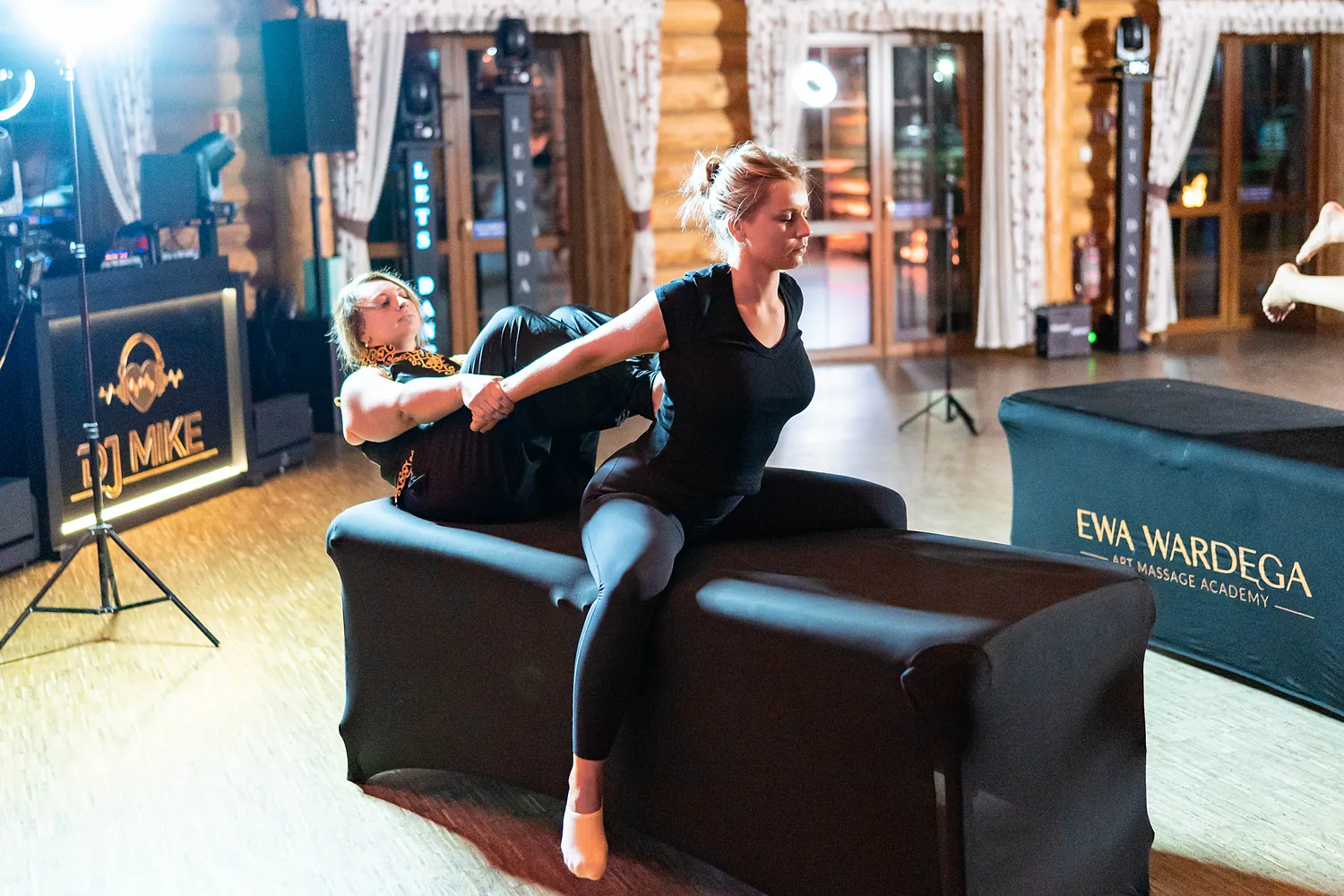
The second number worth asking about is how many people there are per instructor. With twelve pairs in the room, one teacher physically can't correct each person more than a few times a day.
Check who actually teaches the classes
The website usually shows the name of the school's owner. That isn't always the same person who will stand at your table.
Ask directly who teaches a specific date, and look that person up outside their own website. What you want to know is whether they still give massages or only teach, and whether their track record can be verified in an independent source: competitions, publications, presentations, Google reviews signed with a name. The mere fact that someone has been running training sessions for years says nothing about quality, because you can run training sessions badly for a decade.
A good test is to ask about the method. If the instructor can explain in two sentences how their way of working differs from the classic sequence and where it came from, it means they have a well-thought-out system. If the answer is "we teach a bit of everything," you'll get a patchwork.
Insist on a curriculum with named techniques
Compare two descriptions. The first: "you will learn professional relaxation massage and discover the secrets of bodywork." The second: "Balinese massage based on reflexology, acupressure and deep tissue work, Thai yoga massage at the table in a basic version, Hawaiian lomi lomi at a basic level."
The first description tells you nothing. The second tells you exactly what your hands will be able to do after three days, and lets you check whether it will be useful in your practice. How these three massages differ at the table is covered in a comparison of Lomi Lomi, Thai and Balinese massage. That is what the curriculum looks like in the Orient Body Flow® training at Adept level, and you should demand the same level of detail from every school you are considering.
Also check whether the curriculum covers anything beyond technique itself. Pricing your work, contraindications, talking with the client before the treatment and how to add a new service to your price list decide whether the course pays for itself. A skill you can't price or describe to a client stays a hobby.
Understand what the certificate confirms
This is where most misunderstandings happen, so it's worth saying plainly.
A certificate of completion from a commercial course confirms that you attended that training and completed its curriculum. It is not the title of massage technician, which is earned at a post-secondary school and ends with a vocational exam, and it does not entitle you to perform therapeutic treatments. A school that suggests otherwise is misleading you, and that's a bad sign from the start.
A course certificate does, however, have real value in three places: in a job interview at a hotel or spa, in building client trust in your practice and in insuring your business. That's why you should check the practical things. Is there an English version, if you're thinking about working abroad. Is it personalized, and does it list the number of hours and the names of the techniques. Is it issued by someone whose name means something in the industry.
And check the conditions for receiving it. A certificate issued "for attendance" is worth as much as an attendance list.
Read reviews for more than the number of stars
The average rating tells you little, because in this industry almost everyone has five stars. The value is in what the reviews actually say.
Look for reviews in which someone wrote what exactly they learned and what they did with it afterward. A sentence like “great atmosphere and a nice instructor” is probably sincere and completely useless when you are choosing. A sentence like “after the course I added this treatment to my price list and have been offering it for six months” tells you the skill survived contact with a real practice.
Pay attention to critical reviews, if there are any at all. Having none among a hundred ratings is less credible than two remarks about the pace being too intense. Also check where those reviews live. Reviews on Google and Facebook are signed with a profile you can click, while a quote pasted onto a school's website is nothing more than text on the school's website.
The best source, though, is people who finished the course a year ago. If you find someone like that in industry groups, ask them one thing: do they still use what they learned.
Ask about the group size and who you will practice on
On a massage course you practice in pairs, so half the time you are lying on the table and half the time you are working. This has two consequences that few people think about before booking.
First: it matters who is on the table. Practicing on people with different body types teaches you more than three days on one classmate, because pressure that is just right for one person will be too strong or not felt at all by another. Ask whether the pairs rotate.
Second: an odd number of participants, or someone who brings their own model, can throw off the whole day. It is worth knowing in advance how the school handles it.
If you'd rather learn without that whole setup, private training can make more sense, where the pace is set for you and correction is constant.
Count the full cost, not just the course price
The price you see on the website is rarely the amount you will actually spend. To compare two offers, you need four items.
- Accommodation and meals Sometimes included in the price, but usually only at a specific location. In our case, lunches, snacks and accommodation are included only in Solec Kujawski, and for courses in other cities you arrange them yourself. Check this sentence by sentence, because it often makes a difference of several hundred zł.
- Travel and days off A training at the other end of Poland can actually cost more than a seemingly more expensive course closer to home.
- Materials and equipment Course handbook, oil, towels, and sometimes your own table. Ask what you need to bring.
- Booking terms Check whether you pay the full amount up front or reserve a date with a deposit, and what happens if the date falls through on your side. This must be written in the terms and conditions, not agreed by email.
Check what happens after the last day
The biggest loss of skill happens in the first weeks after the course, when you do not have clients yet and the sequence starts to blur in your memory.
That is why you should ask what the school gives you after the course ends. Do you get material you can come back to. Can you ask the instructor a question when something stops working a month later. Is there an option to repeat the course or a day of practice. A school that treats the last day as the end of the relationship leaves you exactly at the moment when help is needed most.
Signs that should make you stop and think
- Promises of specific earnings after the course. Nobody knows your market, your premises or your pace of work.
- A curriculum described only in slogans, without the names of techniques and without a daily schedule.
- No name of the person who actually teaches the classes on your date.
- A certificate presented as a medical or state license.
- Reviews without names and without a source, which cannot be verified anywhere.
- Time pressure as the main argument, instead of information about the curriculum.
In short
- Goal: start by naming what you want to do after the course, because that sets all the other criteria.
- Practice: ask about the proportions and the daily schedule, not the number of hours.
- Instructor: check the specific person and whether they still give massages.
- Curriculum: named techniques instead of slogans, plus a module on working in a practice.
- Certificate: confirms completion of the training, it does not grant a professional title.
- Cost: count accommodation, travel, materials and booking terms, not just the price.
- After the course: materials, contact and the option to repeat are part of the value.
If you already have answers to these questions and want to see how it works with us, the dates, cities and full curricula of each training are in the schedule of upcoming courses. It's also worth checking who the instructor is before you decide, because she is the one who will spend those few days with you at the massage table.
In this article
- First, decide what you want to do after the course
- Check how much time you will spend with your hands on the body
- Check who actually teaches the classes
- Insist on a curriculum with named techniques
- Understand what the certificate confirms
- Read reviews for more than the number of stars
- Ask about the group size and who you will practice on
- Count the full cost, not just the course price
- Check what happens after the last day
- Signs that should make you stop and think
- In short