Guide 8 min read
Eastern massage vs classic massage: how they differ and which to choose
Students often ask me where to start: with classic or with Eastern massage. I write about how these massages differ at the massage table and which one to start with.


People signing up for their first massage training almost always ask the same question: should they start with classic or with Eastern massage. The answer "it depends" is true and completely useless, so it is better to show what it really depends on. The two traditions have different origins, you use your hands differently in each, the person on the table feels them differently, and a therapist develops differently in each.
This text is not meant to settle which massage is better. It is meant to give you a concrete enough picture of both that you can see for yourself which one describes the work you want to do.
Two different lineages
Classic massage, also called Swedish massage, grew out of European thinking about the body. We owe its systematization to the 19th-century Swedish school, and over the following decades it developed in close proximity to medicine and rehabilitation. Hence its language: muscle, attachment, fiber direction, tension, blood flow. Hence also its structure, because classic massage has named techniques and a logical order in which they are applied.
Eastern massage is not a single method but a whole family. It includes Japanese shiatsu, Thai massage, techniques rooted in Ayurveda, and Chinese tui na. They differ a lot from one another, but they share a common foundation: they arose within systems that see a person as a whole, not as a set of muscles to relax. The work there follows lines and points, not the belly of a single muscle. Thai, Balinese and Lomi Lomi massage are compared in a separate article: how they differ and how to learn them.
This distinction is not academic. It translates directly into what happens in the practice.
What the hands do
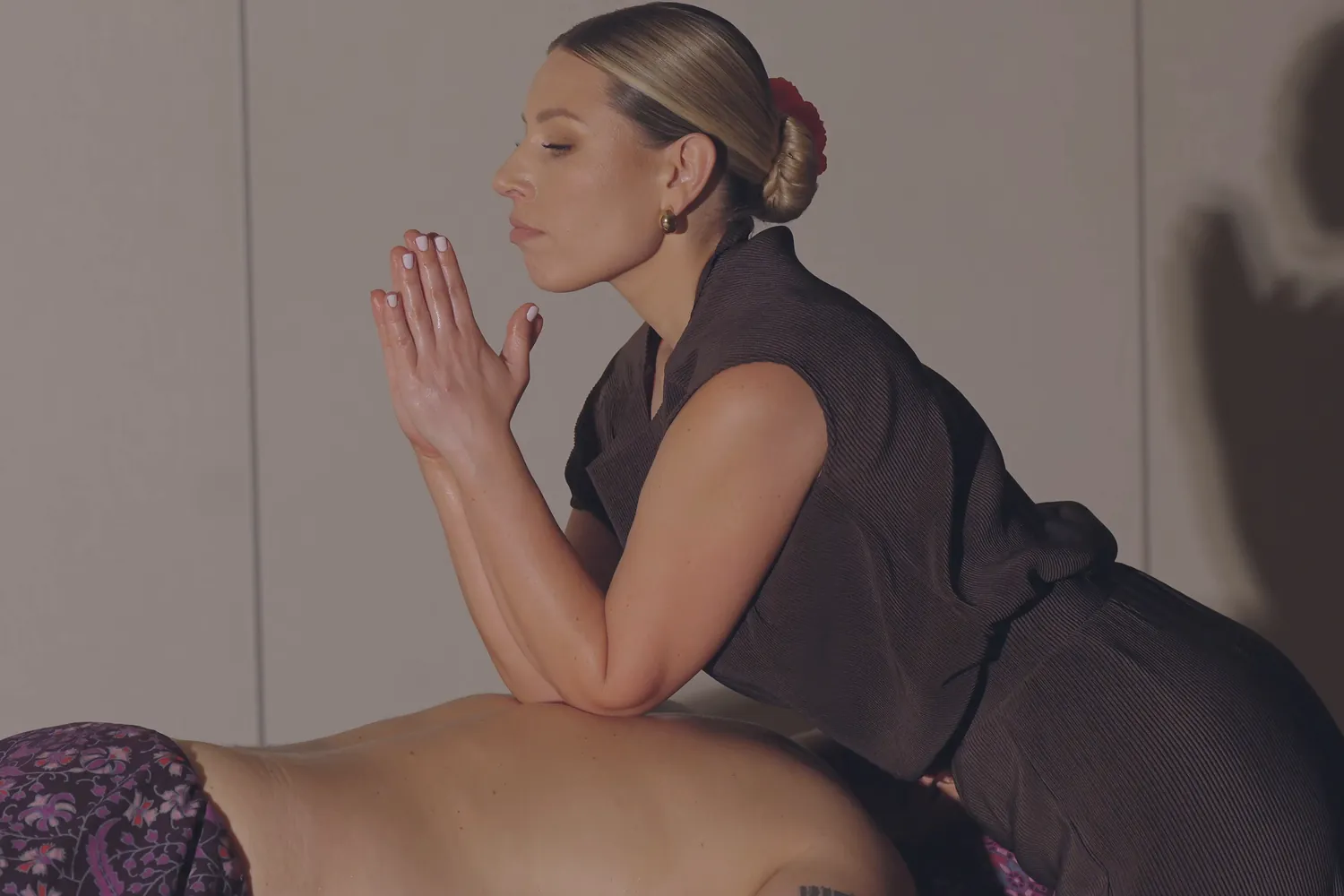
In classic massage you work on bare skin, with oil or lotion, and the client lies on the table covered with a sheet. The techniques are named and countable: effleurage, friction, kneading, tapotement, vibration. You perform them along the direction of the muscle fibers and toward the heart, because one of the premises of this work is supporting circulation. Your main tools are your hands, thumbs and the heels of your hands.
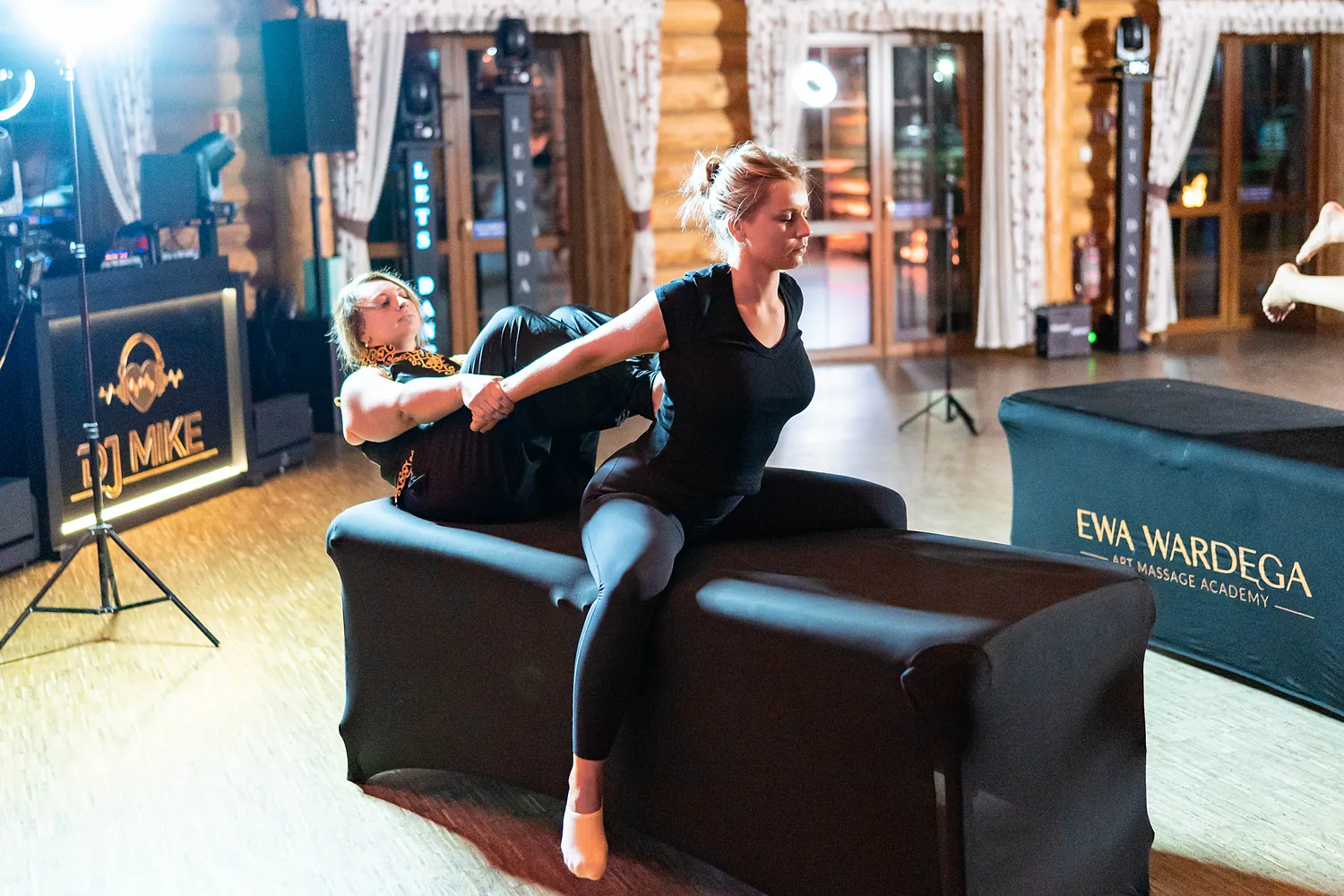
In Eastern massage there are more tools. Besides your hands, you use your thumbs, elbows, forearms, knees, and in Thai massage also your feet. Much of the work is done through clothing or a thin fabric, without oil. Add to that what classic massage almost never has: passive stretching, joint mobilization, and work in several positions, because the client does not lie on their back and stomach the whole time, but is turned onto their side, seated, and guided into bends.
The therapist's own position changes too. Classic massage is done standing at the table. A good share of Eastern techniques are performed from a mat or a low table, often kneeling or squatting, shifting the weight of the whole body, not just the hands.
- 01Classic massageTechniques performed along the muscle fibers, toward the heart.
- 02Eastern massagePressure held longer, entering the tissue gradually, often in rhythm with the breathing of the person on the table.
Pace, breath and working with body weight
If I had to point to one difference that stands out most from the outside, it would be the pace.
Classic massage can be dynamic. It has rhythm, it has accelerations, it has clearly stimulating techniques. You can use it to warm someone up, prepare them for exertion and get them back on their feet after a workout.
Eastern work is usually slower and more repetitive. Pressure is held longer, you enter the tissue gradually, often in rhythm with the breathing of the person on the table. It is not that it is gentler, because it can be very intense. It is that the intensity comes from time and body weight, not from arm strength.
This is, in fact, one of the reasons Eastern techniques can be a lifesaver for therapists with overloaded wrists. Once you learn to apply pressure with your own body weight rather than your forearm muscles, your hands stop being the only resource you have.
How long a session lasts and what the setup requires
The difference in duration is not accidental; it follows directly from how the two methods work.
A partial classic massage, for example of the back alone or the legs alone, usually fits into thirty minutes, and that is enough to do meaningful work. A full-body massage is most often an hour. It can be shortened, because the techniques are modular and you can take just the area that hurts.
An Eastern session does not tolerate shortening well. Since pressure builds gradually and is held longer, and you move smoothly between positions, thirty minutes leaves nothing but rushing. The realistic minimum is usually an hour, and many sequences are designed for ninety minutes or two hours. A client who comes in "to quickly loosen up the neck" will get more out of classic massage.
Length of one session
Classic massage
Partial30 minFull body60 min
Can be shortened to one area, for example the back alone.
Eastern massage
Minimum60 minMultiple sequences90 or 120 min
In a shorter session, the pressure does not have time to sink into the tissue.
The workspace is different too. Classic massage requires a table at the right height, oil, towels and sheets, and therefore laundry. Much of Eastern work takes place on a mat on the floor or on a low table, without oil and without the client undressing, but with plenty of space around, because the therapist moves around the person and changes positions. This has practical consequences: a mat fits where a table will not, but it requires the therapist to have agile knees and hips.
What the person on the table feels
After a well-done classic massage, people most often talk about a specific spot. That the neck let go, that the shoulder blade finally moves, that the calf no longer pulls. The effect is localized, easy to name and easy to check over the following days.
After Eastern massage, the descriptions are less precise and more holistic. That it feels warmer, that the breath drops lower, that the body seems longer or lighter. People name a single muscle less often; more often they describe a state.
It is worth knowing this before you start taking clients, because both answers are correct and both mean the treatment worked. The problem arises when a therapist promises one kind of effect and does work that produces the other.
Which treatment to suggest to a client
When you have both methods in your hands, the choice stops being a matter of taste and becomes part of the client interview. A few situations come up often enough that it is worth having a ready answer for them.
A specific spot you can point to Someone comes in and says: it hurts right here, for two weeks now, since I moved house. This is where classic massage wins, because it lets you work exactly on that spot, long enough and precisely enough.
Fatigue with no address Someone can't point to what hurts; they talk more about tension, poor sleep, not being able to let go. This is a case for Eastern work, because it covers the whole body and doesn't require a diagnosis before you begin.
Sport and recovery Before exertion and right after it, dynamic classic techniques work well. Slow, deep Eastern work fits better on a rest day, not the day before a competition.
A client who doesn't want to undress This can matter, and it won't always be said outright. Techniques done through clothing solve the problem without having to talk about it.
Regardless of the approach, the same safety rules apply. Inflammation, fresh injuries, fever, conditions in which working on the tissues is contraindicated, and any doubts about the client's health are situations in which the treatment is postponed and the client is referred to a doctor. This is not a question of method, but of responsibility.
Which to choose if you are learning the profession
There is no single right answer here, but there are fairly clear indications.
Start with classic massage if you're just getting into the field and have no background related to the body. Classic massage gives you organized anatomy, named techniques and a clear standard for doing it right. It's also easier to make a living from it at the start, because it's what most clients look for and what practices and hotels ask about.
Go Eastern if you already have the basics, and the classic sequence is starting to bore you or tire you physically. Eastern techniques expand your repertoire with stretching, work through clothing and a different use of your own body weight. They also give you something that can't be faked in a service description: a treatment that clearly differs from what the client will get at the salon next door.
If you want to see what this kind of learning looks like in practice, the closest match to this description is the Orient Body Flow® course at the Adept level, where you work along lines and learn to apply pressure with your body weight. On the classic side, the counterpart is Transformational Classic Massage, classic massage structured for real work in a practice, not for an exam.
Can you combine them
It can be done, and in practice most experienced therapists work exactly this way. But combining has its own order.
The worst option is interweaving techniques in random order to make the treatment seem richer. The client then gets a jumble of stimuli with no guiding line and leaves irritated, though no one can say why.
The option that works looks different. You choose one method as the backbone of the treatment, and it sets the pace, the order and the way you finish the work. The second method adds tools where the first has none. For example, you can run the whole treatment in an Eastern rhythm and, at a spot that needs precise work on a specific muscle, reach for a classic technique. The reverse works too: a classic back massage closed with a calm, slow sequence of stretches comes across much better than a sudden “all done, please get up.”
There is one condition. To mix consciously, you first need to know each method on its own. Combining two things you have not fully mastered does not give you a third thing, only chaos.
In short
- Origin: classic massage grew out of European medicine and rehabilitation, Eastern massage out of Asian systems of working with the whole body.
- What the hands do: classic massage means oil, exposed skin and work along the muscle. Eastern massage often means clothing, elbows and forearms, work along lines and stretching.
- Pace: classic massage can be dynamic, Eastern massage is usually slower, guided by body weight and breath.
- Effect: after classic massage, the client talks about a specific spot; after Eastern massage, about how the whole body feels.
- Learning: with no basics, start with classic massage. With the basics, Eastern massage will give you new tools and take the load off your wrists.
- Combining: yes, but one method has to be the backbone of the treatment and the other an addition.
None of these distinctions can be fully understood from a text. The difference between reading about pressure applied with body weight and feeling it under your own elbows becomes clear after a dozen or so minutes at the massage table. If you want to try it for yourself, take a look at the schedule of upcoming trainings and choose the approach that feels closer to you after reading this.
In this article