Guide 7 min read
A massage therapist's wrists: how to work so they hold up
Thumb and wrist pain rarely comes from the client's strength. It comes from the table height, your body position and using one tool all day long.

Among massage therapists who have been working for more than two years, sore thumbs and wrists come up in every conversation. Usually along with the belief that this is just how it is, that it is the cost of the job and you have to pay it. Well, not quite.
Overload rarely comes from a client having a strong back. It comes from repetition and from where the pressure originates. The good news is that both of these can be changed, without giving up deep work. The bad news is that it takes rebuilding a habit, not buying a better oil.
Where overload really comes from
A massage therapist's hand loses to arithmetic. In a single treatment you perform several hundred repetitions of the same movement, and if you have four treatments of the same type in a day, you do them in an almost identical body position. The tissues never get a chance to rest, because nothing in their work changes.
On top of that come two habits you see in most people who learn on their own. The first is using the thumb as the main tool, because the thumb gives the best control and hits the point fastest. The second is pushing the pressure onto a wrist held in strong extension, that is, in the position where the joint has the least room, and yet the entire load of the work goes through it.
Each of these on its own is bearable. Together, repeated over several years, they are the main reason people leave this profession.
Table height sets up everything else
This is the simplest change and the one most often overlooked, because the table usually stands at a height someone set at some point and no one has touched since.
A table that is too high forces you to work with your arms alone, because you can't get your body weight over the client. A table that is too low saves your hands, but at the cost of your back, because you work bent over the whole time. The starting point is simple: standing at the table with your arms hanging along your torso, your wrists should reach the tabletop. For deep work set it lower, for precise work and fine techniques set it higher.
The test is even simpler.
If you raise your shoulders or go up on your toes when applying pressure, the table is too high.
If your lower back hurts after a treatment, it is too low. Change the height between treatments instead of setting it once and for all.
Pressure should come from weight, not strength
Every student hears this sentence, and almost everyone understands it only when someone moves their torso twenty centimeters further.
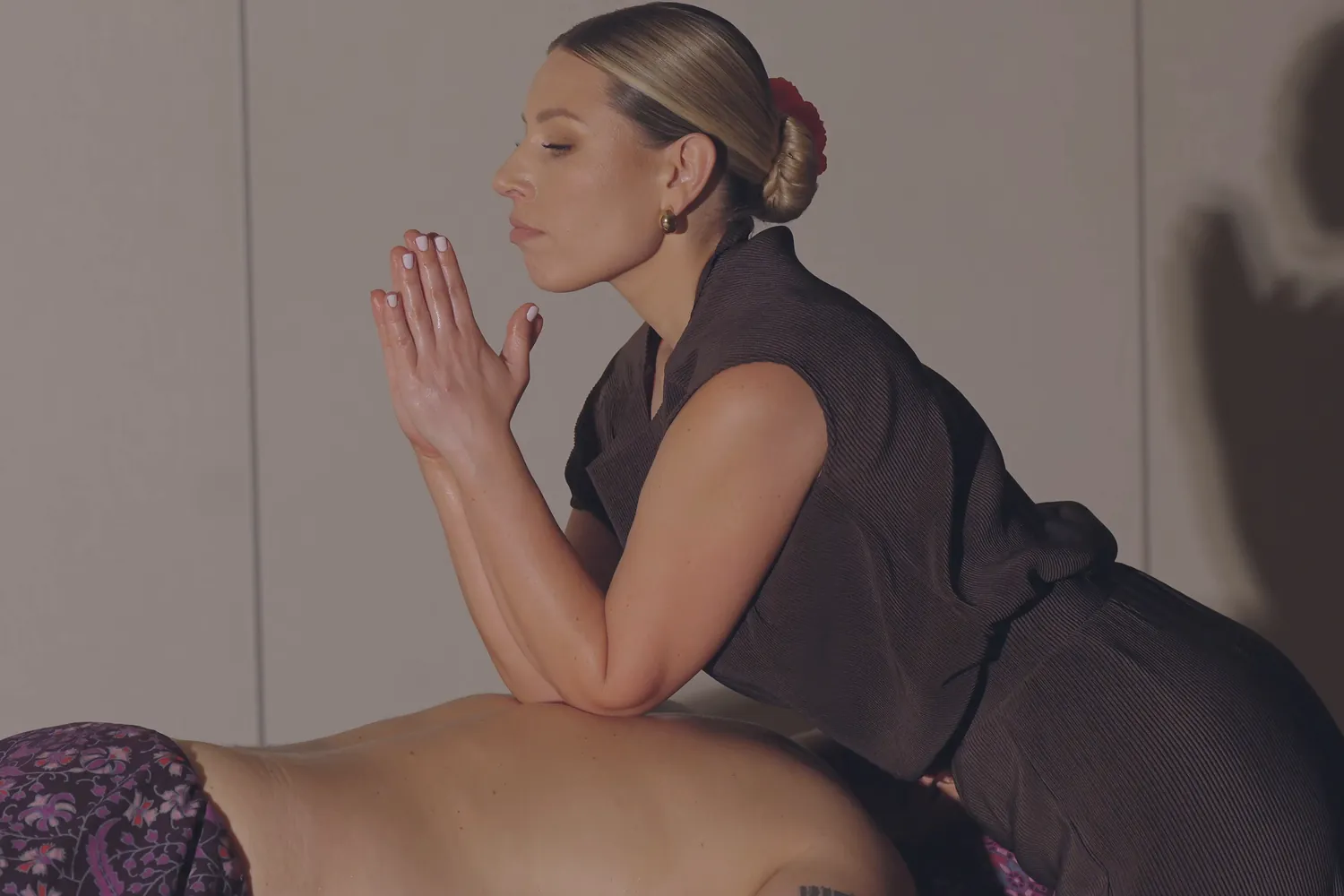
Working with strength looks like this: you stand next to the table, your elbow is bent, your arm is tense, and you push the pressure out with the muscles of your shoulder and forearm. Working with weight looks different: you position yourself so that your torso is over the spot you are pressing on, your elbow stays almost straight, and you shift your center of gravity forward and let the pressure come from your body mass. Your arm then becomes a transmitter, not an engine.
The difference is felt on both sides of the table. You stop getting tired after the third treatment, and the client receives pressure that builds evenly and predictably instead of a jerky push. That is why in Eastern methods, where pressure is applied with body weight, the pace is slower: mass needs time to sink into the tissue, while strength tries to cut that time short. What pressure and body work look like in Thai, Balinese and Lomi Lomi massage is described in a comparison of these three massages.
Keep your wrist in line with your forearm
There is one rule, and it applies regardless of technique: the closer to a neutral position, the lower the load on the joint.
- 01Gentle anglePressure goes through the heel of the hand, and the wrist stays almost in line with the forearm.
- 02At a right angleThe line breaks at the wrist. Avoid this position when working with the heel of the hand.
In practice, this means a few specific things. When pressing with the heel of your hand, guide your arm so that the forearm, wrist and metacarpus form as straight a line as possible, instead of breaking it at a right angle. Don't push off the table with your fingers in extreme extension. Don't rescue a tired grip by adding tension in your forearm, because that only moves the problem higher up.
The thumb deserves a paragraph of its own. The thumb is a great tool for point work and a terrible one for moving weight over a long stretch. If you use it as your main source of pressure throughout a treatment, the question is not whether your wrist will protest, but when. For point work, use your thumb briefly and in a position where it is supported, and hand the long strokes over to larger tools.
Change the tool, not just the technique
The most effective prevention is not having one favorite tool. Each has a different reach, a different precision and a different cost for you.
- Heel of the hand A large surface, good for spreading and warming up, not very precise.
- Fist More pressure than the palm, provided the wrist stays in line with the forearm.
- Forearm Broad, even pressure on large areas, practically zero cost for the wrist. The most underrated tool in the classic toolkit.
- Elbow The deepest point work with the least effort, but it requires a fine touch, because you do not have sensation in it comparable to your hand.
- Foot The largest surface and the most available mass, while your hands rest in the meantime.
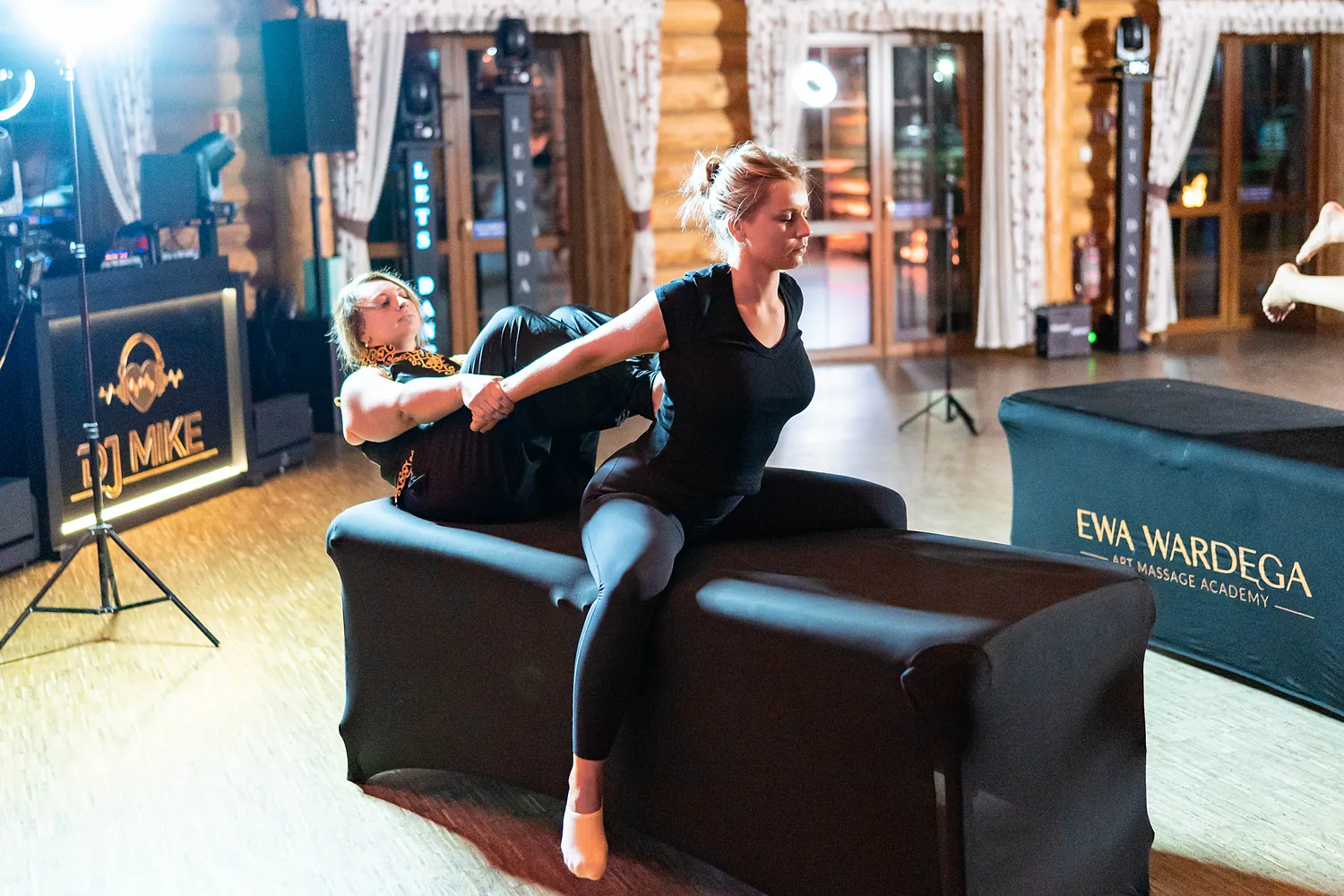
The last point sounds exotic only in Poland. Working with the feet has been standard in Asia for centuries, and in a version adapted to the massage table it lets you achieve pressure you cannot reach with your hands without straining yourself. That is the whole idea of barefoot massage in the A‑Shiatsu method: the force of the pressure shifts from the hand to the foot, so the massage is deeper and the wrists take no part in it.
If you prefer to stay with manual work but want to stop carrying everything on your thumbs, the starting point is organized work with the forearm and elbow, as in deep tissue massage, where depth comes from positioning and pace, not from pressing harder.
Four things to check during your next treatment
Theory becomes a habit only when it takes the form of a short list you remember at the table. This one is short enough to keep in your head as early as tomorrow.
Check your shoulders halfway through the treatment If they are raised toward your ears, you are sending tension to a place that does not need it. Lower them consciously and see whether the pressure has actually weakened. If it has not, it means you were previously working with your shoulder instead of your weight.
Count how many times you reached for your thumb Not to stop using it, but to see the scale. Most people are genuinely surprised by the result.
Notice the moment you start to rush That is usually when the old pattern comes back: shorter range, more force, less weight transfer. That is exactly the part of the treatment that costs you.
Ask the client one thing Did the pressure build evenly, or did it come in jumps? The answer will tell you more about your work with body weight than your own sense in your hand, because you do not feel your own pressure the way the person on the table feels it.
Your schedule is part of your technique
You can have flawless body positioning and still overload yourself just through how your day is laid out.
Four deep tissue treatments in a row means the same movement for five hours. If you have a day like that, alternate: strong work, then something calmer, then strong again. Also spread the hardest treatments across the hours when you are fresh, because a tired hand starts looking for shortcuts on its own and goes back to the thumb.
Breaks between clients are not just for airing out the practice. A few minutes to loosen your hands and straighten up really does change the load over the course of a week. The same goes for warming up before the first session, which most people skip, even though any athlete would find skipping it absurd.
What to do when it already hurts
A clear line needs to be drawn here, because this is where the internet usually gives advice it shouldn't.
Fatigue after a hard day that goes away overnight is a normal response to effort and a signal to review your table setup and your choice of tools. Pain that comes back every day, wakes you at night, radiates, or comes with numbness, tingling or a weaker grip is a completely different category. Then you don't change your hold, you go to a doctor or a physiotherapist, because this is something to be examined, not solved by correcting your technique.
It's worth saying plainly: no text on the internet, including this one, can replace a diagnosis here. Putting off a visit in the hope that it will pass on its own costs the most in this profession.
What you can't fix from a text
You can understand everything above in ten minutes and still not be able to apply it, because you can't see your own posture. People who work with their wrist bent at a right angle are usually convinced they are holding it straight, until someone stands next to them and corrects their hand.
So the fastest way is one day of work at the massage table with someone who watches and corrects you as you go, and the cheapest, though slower, is to record yourself with a phone set up to the side and watch it without mercy. You will see raised shoulders, a bent elbow and how often you go back to your thumb when you start to rush.
In short
- Cause: repetition plus pressure generated by the strength of the hand instead of body weight.
- Table: set it for the technique and adjust it between treatments, not once and for all.
- Pressure: torso over the spot you are working on, elbow almost straight, the arm as a transmitter.
- Wrist: as close to the line of the forearm as possible, the thumb only briefly and only for point work.
- Tools: the forearm, elbow and foot take the load off your hands without losing depth.
- Schedule: alternate types of treatments and don't leave the hardest ones for the end of the day.
- Pain: if it keeps coming back, shows up at night or comes with numbness, it is a matter for a doctor, not for a change of grip.
Changing the way you transfer pressure is one of those things that look trivial on paper but under your hands turn out to be a new habit to build from scratch. If you want to practice it under the eye of someone who will correct your positioning before it becomes second nature, take a look at the schedule of upcoming training sessions.
In this article
- 01Where overload really comes from
- 02Table height sets up everything else
- 03Pressure should come from weight, not strength
- 04Keep your wrist in line with your forearm
- 05Change the tool, not just the technique
- 06Four things to check during your next treatment
- 07Your schedule is part of your technique
- 08What to do when it already hurts
- 09What you can't fix from a text
- In short